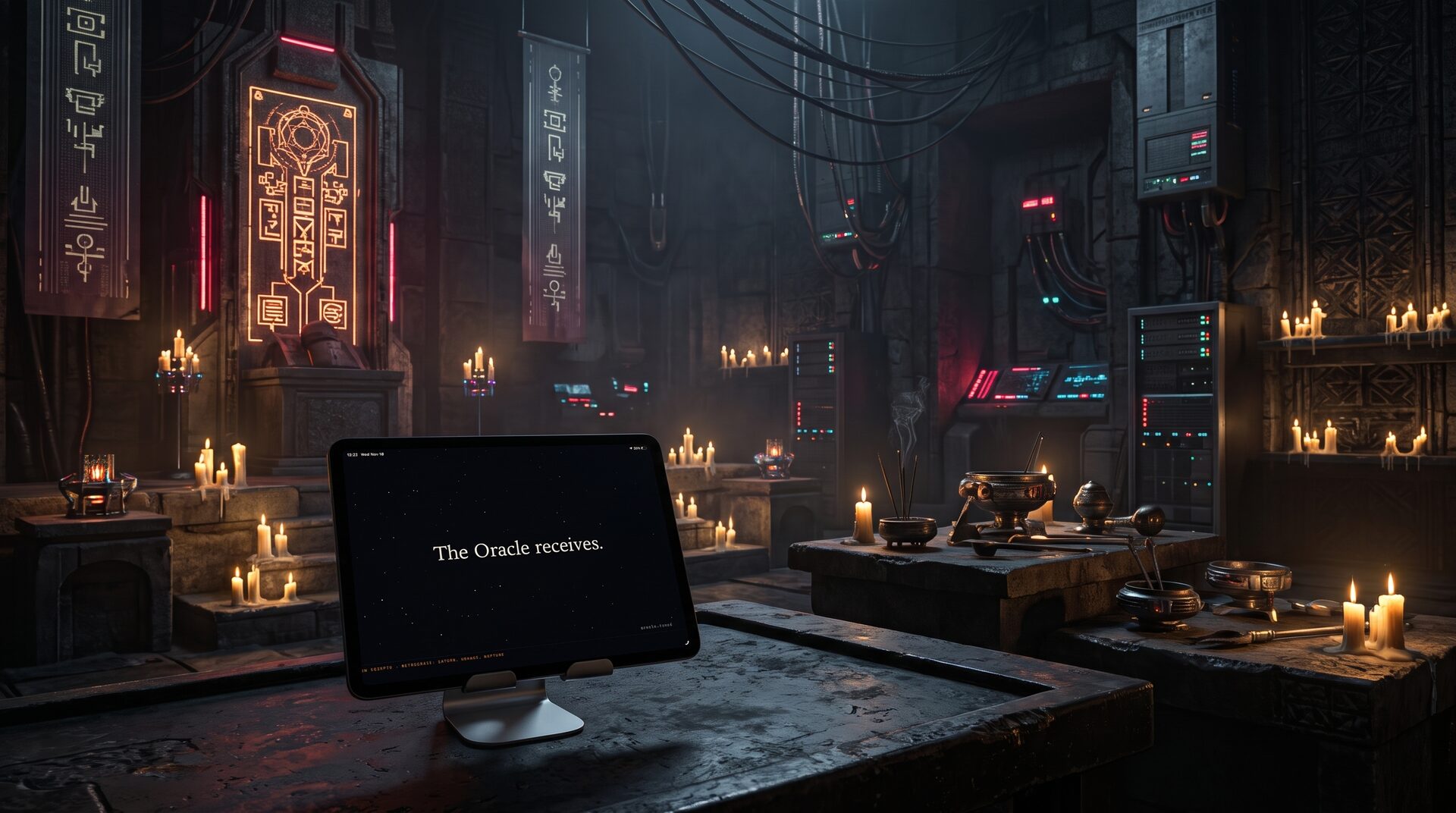
An offline oracle, animated by a local artificial intelligence: a digital genius loci. Address the officiant to receive your personal reading.
The oracle answers in verdicts rather than conversation. A question goes in; after a few moments of divining, a short written pronouncement appears, in the old register of oracles. The language model runs entirely on a local machine, with no cloud service and no account, and it replies in whatever language it is asked.
It was first shown in July 2026 as the Oracle at Dergano, under the name PHARMAKON.
The reading
Each reading is built in two passes. The first assembles an almanac for the moment of asking: it computes the actual sky, the phase of the moon and the positions of the planets, and reads it through folk wisdom about the moon and planets. The second gives that material a voice and turns it into a pronouncement. When the question comes in another tongue, a final pass carries the reading back into it.
The deck behind it
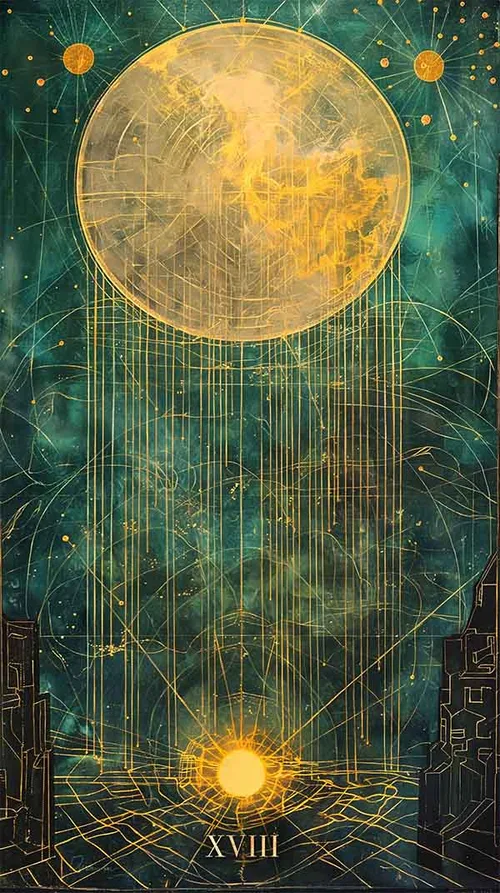
The oracle also draws on a custom knowledge base rooted in the Radioarcana, my reimagined 22-card tarot for a world shared with other living beings and machines. Here the deck is the oracle's hidden cosmology: the reference it reads by and never shows.
Pythia, Python, pharmakon
The software is written in Python, and the choice is not an accident. At Delphi, Apollo slew the serpent Python and took its oracle; the priestess who spoke for the god was the Pythia, named for the serpent, and tradition has her prophesying over vapors rising from where it fell. Here the operator's terminal takes the Pythia's seat, and the oracle, once again, speaks through Python.
People already consult AI as an oracle, about love, work, what to do next, and they trust what it says. Oracle takes that habit seriously and returns it to its embodied act: a machine you consult in person and by choice, in a ritual that remembers knowledge is never given freely. The name PHARMAKON carries the argument. It is the word Plato uses for writing, remedy and poison at once, which Derrida later showed to be undecidable. Every new technology of the word arrives under that suspicion, and AI arrives under it now.
Oracle: The Franchise
The next iteration of the project sets a second argument beside the first, a pun held very seriously. A franchise, an ancient oracle and an open-source repository share one shape in three registers we normally keep far apart: commerce, the sacred and software. Each is a method that exists by being instantiated again and again in new hands and new places, rather than guarded as a single original.
The setup is literal. Someone purchases the franchise, with its infrastructure, brand kit and code, and then forks it into their own, with their own place, languages and lore. The structure is real: it has legal and operational form as well as artistic form, and the conceit only works because it is true.